Amekpoagbe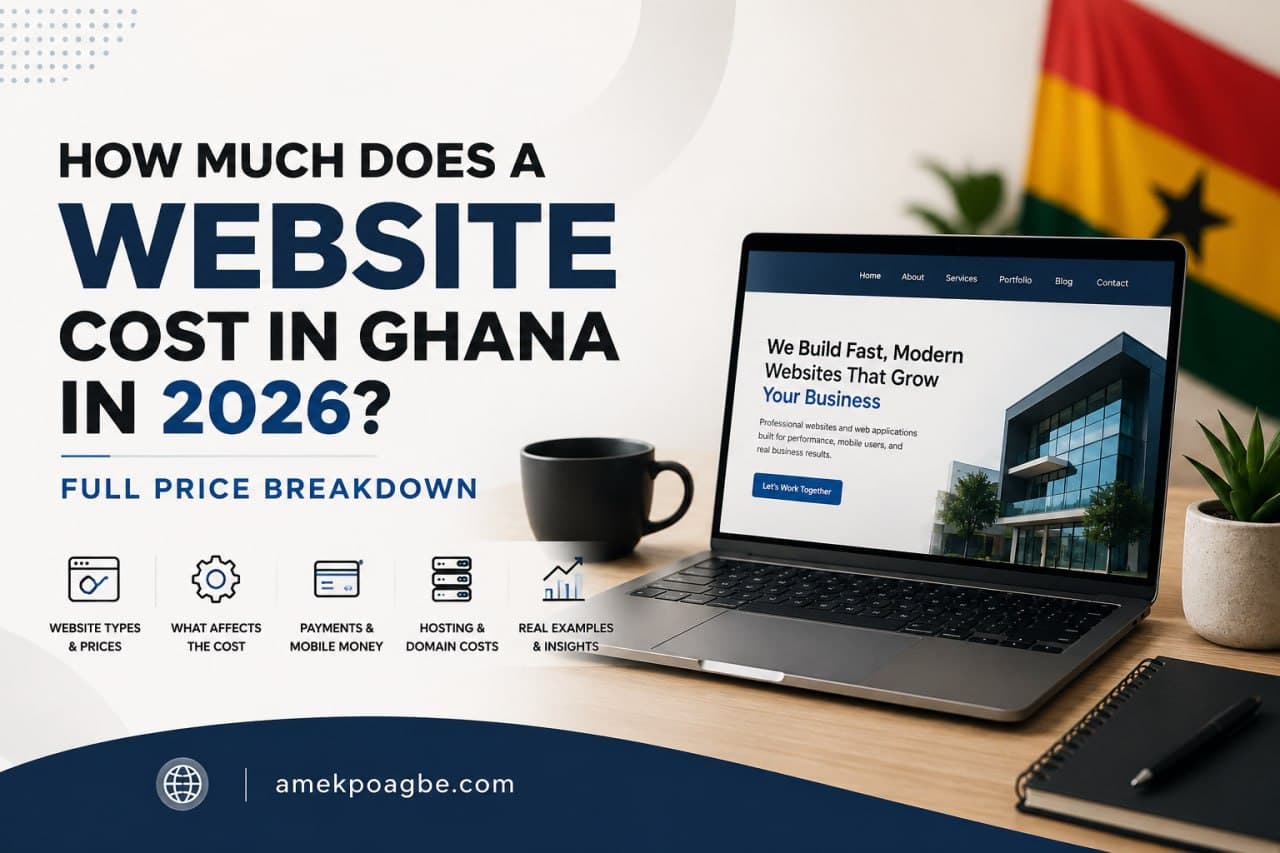
If you are a business owner in Accra, Kumasi, or anywhere in Ghana, you have probably asked yourself: how much should I actually pay for a website?
It is a fair question. Quotes from different developers can range anywhere from GH¢500 to GH¢50,000, and without context, there is no easy way to know what is reasonable. That confusion is normal, and it almost always comes down to one thing: not knowing what actually drives the price.
My name is Daniel Amekpoagbe. I am a full-stack web developer based in Accra, and I have built websites for Ghanaian businesses across the board, from simple landing pages to full e-commerce platforms. This guide breaks down every factor that affects website pricing in Ghana in 2026, so you can plan your budget with clarity and hire with confidence.
The Short Answer
Before diving into the details, here is a quick reference for what different types of websites typically cost in Ghana right now.
| Type of Website | Price Range (GH¢) | Price Range (USD) |
|---|---|---|
| Basic 1-page website | GH¢1,500 to 3,000 | $100 to $200 |
| 5-page business website | GH¢3,000 to 7,000 | $200 to $500 |
| E-commerce store | GH¢8,000 to 25,000 | $550 to $1,700 |
| Custom web app or portal | GH¢15,000 to 50,000+ | $1,000 to $3,500+ |
| Website redesign | GH¢2,500 to 10,000 | $170 to $700 |
These ranges reflect the current market in Ghana. Wide ranges are intentional because no two projects are the same. The rest of this guide explains what pushes a project toward the lower or higher end.
What Determines the Price?
1. Number of Pages
A one-page brochure site can be completed in two to three days. A ten-page business website with a services section, about page, portfolio, blog, and contact form typically takes one to two weeks. More pages mean more time, and more time means a higher cost. This is one of the simplest factors to understand and plan around.
2. Custom Design vs. Templates
Template-based websites (GH¢1,500 — 3,000): Built on pre-made designs. They are faster to produce and more affordable, but your site may look similar to many others online.
Custom-designed websites (GH¢4,000 — 10,000): Built from scratch to match your brand, color palette, and visual identity. They take longer but leave a much stronger first impression.
3. Features and Functionality
This is the single biggest price driver on any project. The more complex the functionality, the longer it takes to build and test correctly.
Contact form: Minimal added cost
Blog or CMS: Moderate cost, requires a content management system
Payment integration (Paystack, Flutterwave, Mobile Money): Moderate cost
E-commerce (product catalog, cart, checkout, inventory): Higher cost
Admin dashboard (custom login, reports, management tools): High cost
SMS notifications: Moderate cost
When you are scoping your budget, list every feature you want and be honest about which ones you truly need for launch versus which ones you can add later.
4. Domain and Hosting (Recurring Annual Costs)
These are costs most people forget to account for. Your website needs a domain name and a server to live on, and both are renewed every year.
| Item | Annual Cost (GH¢) |
|---|---|
| Domain (.com.gh) | 150 — 300 |
| Hosting (basic) | 500 — 1,200 |
| Hosting (e-commerce) | 1,200 — 3,000 |
| SSL Certificate | Often free with hosting |
A good developer will include these in their cost breakdown so there are no surprises after launch.
5. Mobile Money and Payment Gateways
In Ghana, Mobile Money integration is not optional for most businesses. Here are the main options and their transaction fees:
Paystack: 1.9% + GH¢1 per transaction, supports MoMo, Visa, and Mastercard
Flutterwave: 1.4% per transaction, supports MoMo, Airtel Money, and cards
Hubtel: A local Ghanaian payment processor with strong local support
Integrating any of these typically adds one to three days of development work to your project, which increases the build cost. But for any business selling online, it is a non-negotiable investment.
Real Examples from My Projects
Example 1: Small Business Website — GH¢4,000
5 pages: Home, About, Services, Contact, Blog
Custom design matching brand colors and identity
Contact form with WhatsApp integration
Fully mobile responsive
Basic SEO setup
Timeline: 1 week
Example 2: E-commerce Store — GH¢15,000
20+ products with full catalog management
Paystack and Mobile Money integration
Admin dashboard to manage products, orders, and customers
SMS order notifications
Shipping management
Timeline: 3 to 4 weeks
Example 3: Delivery Service App — Custom Quote
Real-time order tracking
Rider dashboard
Customer-facing mobile portal
Payment integration
Admin analytics panel
Timeline: 4 to 6 weeks
Hidden Costs to Watch Out For
Even after agreeing on a development price, there are often additional costs that catch business owners off guard.
Content creation: If you do not have your copy, photos, and brand graphics ready, expect to budget GH¢500 to 2,000 for this.
Ongoing maintenance: Websites need regular updates, backups, and security checks. Budget GH¢300 to 800 per month for a basic maintenance plan.
SEO: Getting found on Google does not happen automatically. Ongoing keyword research, content writing, and link building typically costs GH¢500 to 2,000 per month.
Professional email setup: A branded email address like you@yourbusiness.com costs roughly GH¢300 to 600 per year and is worth every cedi for credibility.
How to Choose the Right Developer in Ghana
Not all developers are equal, and the lowest quote is rarely the best deal. Here is what to look for and what to avoid.
| Red Flags ❌ | Green Flags ✅ |
|---|---|
| Suspiciously low quotes (under GH¢800) | Transparent pricing with a clear breakdown |
| No portfolio or examples to show | Real, live projects you can visit and interact with |
| Uses free templates without disclosing it | Explains technology choices clearly and honestly |
| No contract or defined timeline | Written agreement with project milestones |
| No post-launch support offered | Includes a maintenance or support package |
Always ask a developer to show you past work, explain their process, and put the project scope in writing before any money changes hands.
Need a website for your business? Talk to me.
DIY vs. Hiring a Professional
When to Build It Yourself
You need a simple, one-page online presence
You have two to four weeks to invest in learning
You are working with a very limited budget
Tools to consider: Wix, Squarespace, or Wordpress, which typically cost GH¢200 to 500 per year. These platforms are beginner-friendly but have significant limitations as your business grows.
When to Hire a Professional
You need e-commerce or payment integrations
You want features that templates cannot accommodate
Your website needs to actively generate leads and sales
You need it done correctly the first time
You do not have time to learn and troubleshoot a platform
For most serious businesses, hiring a professional is the right call. A well-built website is not a cost; it is an asset that works for you around the clock.
What to Do Next
Getting started is straightforward when you break it into steps.
List your requirements — pages, features, payment methods, and any integrations you need
Set a realistic budget — use the pricing table above as your reference point
Contact two or three developers — ask for quotes, timelines, and portfolios
Ask about post-launch support — your website will need maintenance, and you want a developer who stands behind their work
Need a website for your business? Talk to me.